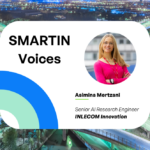
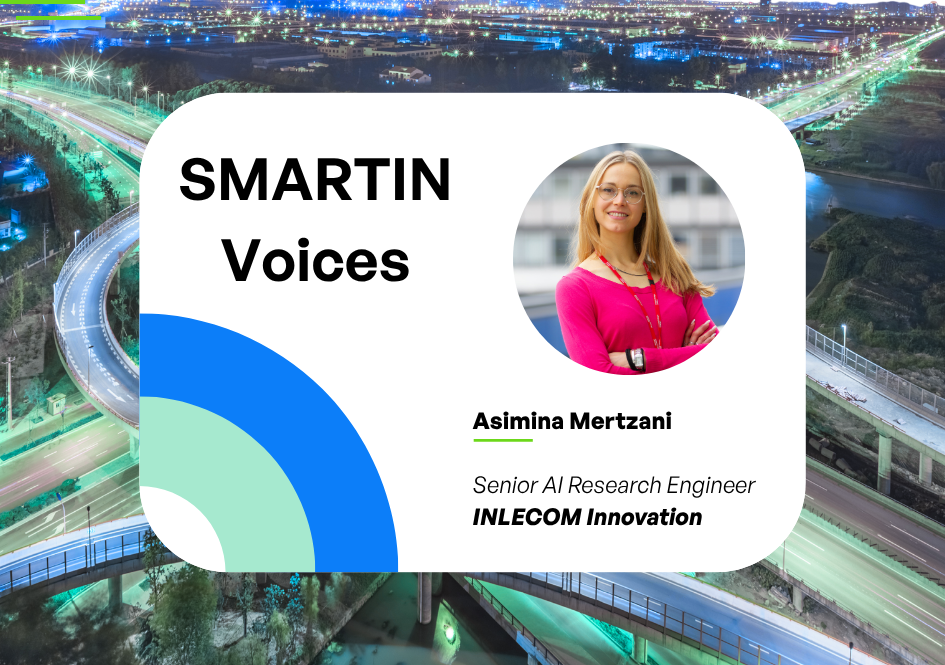
SMARTIN brings together experts from across Europe to develop digital solutions that can transform the way transport infrastructure is monitored, managed and optimised. Through SMARTIN Voices, we highlight the people contributing their knowledge and expertise to make this vision a reality.
For this third interview, we speak with Asimina Mertzani from INLECOM Innovation about her work on AI-powered infrastructure monitoring, the importance of developing human-centred and explainable AI, and how advanced digital technologies can support more proactive and informed infrastructure management.
—
Could you briefly introduce yourself?
I am a Senior AI Research Engineer at INLECOM Innovation and a Postdoctoral Research Fellow at the Hellenic Open University. My background is in electrical and computer engineering, applied machine learning and artificial intelligence, including a PhD from Imperial College London. My work focuses on interpretable, human-centred AI and hybrid human–computer multi-agent systems, with applications in infrastructure monitoring, transport safety and climate resilience.
What motivated you to pursue a career in your field?
I initially chose electrical and computer engineering because I was fascinated by how humans have transformed electricity and computation into machines with extraordinary capabilities. During my studies, I became increasingly interested in artificial intelligence and its potential to reshape society. As I explored the field through my MSc and PhD, I wanted to understand how AI systems could work alongside people, particularly through hybrid human–computer multi-agent systems, so that technological progress contributes to human flourishing rather than creating harmful outcomes.
- What is your role and your organisation’s role within SMARTIN?
I lead Work Package 3, which develops tools for holistic infrastructure monitoring, control, and predictive assessment, and I coordinate SMARTIN activities from INLECOM’s side. INLECOM also leads the development of methodologies and criteria for assessing infrastructure health and transport performance. My technical work focuses on the AI Engine, covering data analysis, predictive assessment, contextual correlations and maintenance simulations, as well as ensuring that these outputs are integrated, visualised and made accessible to infrastructure operators and other end users.
- What impact do you expect your work to have on the project’s objectives?
I expect our work to support the transition from periodic and reactive infrastructure management towards more proactive, evidence-based practices. By combining monitoring data, inspection findings, contextual information and historical events, the AI solutions can help identify risks earlier, assess infrastructure condition, and explore maintenance scenarios. Most importantly, these tools are designed to support human users by providing clear, relevant and explainable information, enabling infrastructure operators and decision-makers to make better-informed and more timely decisions.
- From your perspective, what makes SMARTIN innovative or particularly relevant for the future of transport infrastructure?
What makes SMARTIN innovative is the way it brings complementary technologies into a single operational architecture rather than developing isolated tools. It combines digitalised infrastructure assets, smart connectivity, AI-driven data fusion, predictive maintenance and multimodal mobility services to support more proactive and informed management. Its user-centred approach and validation across four diverse European urban contexts also make it highly relevant: the solutions are designed not only to be technologically advanced, but interoperable, transferable and practically adoptable by infrastructure operators.
- As an AI Research Engineer, how do you ensure that advanced AI technologies translate into practical solutions that genuinely support end users?
For me, it starts with listening to the people who will actually use the technology. We involve end users throughout the process, from co-designing the solution to testing it in realistic settings and refining it based on their feedback. I also believe AI outputs need to be clear and explainable, not just technically accurate. When users can understand and trust what the system is showing them, they are much more likely to use it and benefit from it in their daily work.
- AI is evolving rapidly. Which AI technologies or approaches do you believe will have the greatest impact on the future of transport infrastructure management?
I believe the greatest impact will come from AI that combines data-driven methods with engineering knowledge, physical models and human expertise. Physics-informed, neurosymbolic and explainable AI can produce predictions that are not only accurate, but also easier for operators to understand, question and validate under human oversight. Multimodal AI will also be important for bringing together sensor data, images, reports and contextual information, while predictive analytics and scenario simulation can help anticipate risks and compare possible interventions.
—
Stay tuned for the next edition of SMARTIN Voices, where we continue to showcase the people and expertise driving innovation across the project.